Sustainability
Sustainability at NRS
A double-sided sustainability for your safety and our climate.
We describe our approach to the environment in the NRS Code of Conduct.
We believe that our greatest contribution to sustainability is our efforts to create products that require less steel than competing products in similar capacity classes.
To achieve this, we are investing significant resources in product development. We are the only company in the Nordic region with our own equipment for crash testing of railing systems and our own resources for computer simulations.
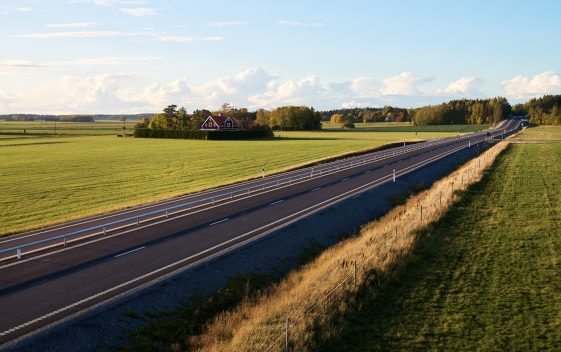
Sweden’s climate goals


Our product development work aligns with several of the Swedish Transport Administration’s (Trafikverket) climate targets
- Energy-efficient and lower climate impact solutions in the construction, operation, and maintenance of infrastructure.
- A climate-neutral infrastructure by 2040 at the latest.
- Requirements for suppliers in investment and maintenance projects to reduce the infrastructure’s climate impact.
- Research, development, and demonstration projects that contribute in various ways to the development of climate-neutral materials, fuels, and electrification within the civil engineering and construction sector.
- Targets and requirements to reduce climate impact in other countries resulting from the procurement of materials for infrastructure construction and maintenance on an international market.
Environment Product Declarations, EPD, for our products
Road safety barrier’s purpose is to increase traffic safety by preventing vehicles from driving off the road, into dangerous objects or into objects that need protection from colliding vehicles. Based on road classification, there are specific rules and guidelines for choosing a combination of guardrail and pole so that the road safety barrier can function optimally depending on the situation.
A safety barrier system consists of two parts. A horizontal guardrail and a vertical post that is assembled on site with screws and built into the ground at the roadside. Both parts are galvanized steel sheet profiles that have different shapes and steel qualities depending on use and road safety requirements.
EPD verified for specific products, see EPD International.
S-P-07329 Galvanized steel components for safety barriers
In this EPD the product under assessment is the safety barrier that includes rounded, rectangular, beam, and flat steel profiles with steel strength classification S235, S355 and S420. Materials used for this product are produced in factories located in Sweden.
S-P-06851 Pole for traffic barriers
In this EPD the product under assessment is the vertical pole that includes profiles C and Sigma and steel strength classification S235 and S355.
S-P-06849 Guardrail for traffic barriers
In this EPD the product under assessment is the horizontal guardrail that includes all profiles (W,K and M) and steel strength classification S235, S355 and S420.
Current sustainability work right now
After conducting a double materiality analysis in 2023, we have identified our most important sustainability aspects. They are linked to the following global goals:
Decent work and economic growth
Our goal:
At NRS, it is a pleasant and safe working environment. There must be no serious workplace accidents.
Industry, innovation and infrastructure
Our goal:
Sustainable growth. Ongoing product development projects with a focus on sustainable innovations.
Responsible consumption and production
Our goals:
Reduced resource use through lower zinc levels and less material consumption throughout the value chain. Increased recycling rate through the use of recycled steel.
Climate action
Our goal:
We will be the best in the industry for green traffic safety solutions and gradually increase the possibility of choosing recycled steel in all our systems.